Showing posts with label Feminism. Show all posts

Saturday, July 2, 2011

One Weekend, Two Different Kinds of Celebrations

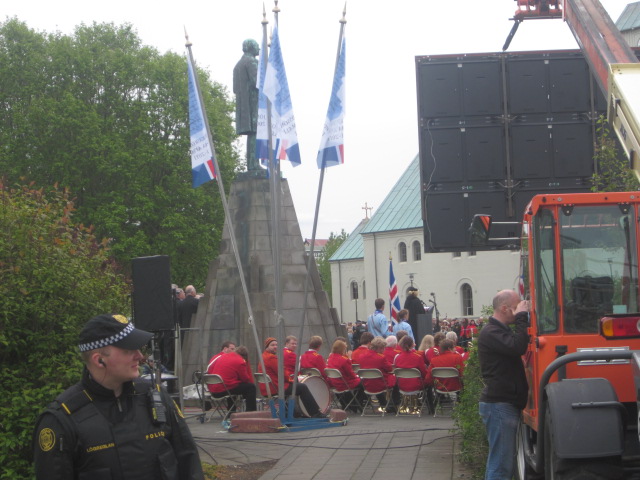
June 17 is Iceland's Independence Day, celebrating the formal end of Danish rule on June 17, 1944.  The day was chosen because June 17, 1811 was Jón Sigurðsson's birthday, who is seen as a leader of Iceland's movement for independence (you can read more about him here), and so of course this year being the two hundredth anniversary of his birth there have been a variety of special events.  Like the 4th of July in the U.S., June 17th is a big day for celebrating.

That's Jon surrounded by flags.
We enjoyed the festivities in Reykjavík (of course celebrations are held all over the country) which began with the formal government event in front of the parliament building, continued with a procession to the cemetery where a wreath was laid on Sigurðsson's grave.  In good democratic fashion, this part also included some protesters, including those who are opposed to Icelandic membership in the EU, and those who are protesting what they see as the lack of accountability after the financial crisis.  In the afternoon, the party continued all over the downtown with a parade down Laugavegur, musical and street theater performances, and lots of entertainment for the kids.

Parades in Iceland are fun because they are participatory events.  The parade was led by scouts carrying flags, a band, and a street theater, but then everyone joins in the parade.


A few photos of scenes from the parade.


It was a real family day too, and there were antique cars, a small area with carnival rides, and lots of places for the kids to jump and bounce.  These jumping rooms are very popular here and every event seems to have them.

Also lots of cotton candy, and hot dogs, and helium balloons with all kinds of characters.  And of course where there are helium baloons, there are children losing their grip on the balloon, and everyone watches it float up into the sky with the sound of a disappointed child in the background.

As I have mentioned before, this year is also the one hundredth anniversary of the Unviersity of Iceland, which for the first thirty years, from 1911 to 1941, met in the parliament building.  So the building was open in honor of that anniversary, and it was fun to see the building in general (which is not often open to the public) and in particular to see the rooms where university classes met.
One of the rooms where University of Iceland
classes met at the parliament building.

The best part of the day was just being part of the generally positive spirit of the celebration, Icelanders celebrating their Icelandicness.

Two days later, on June 19, we attended another celebration, much smaller in scale, and with a different focus: to mark the anniversary of women gaining the right to vote in Iceland in 1915. (Actually originally it was just women who were over 40; then the age was gradually reduced over the next few years).

The event began at the cemetery, with music and readings and a wreath-laying at the grave of Bríet Bjarnhéðinsdóttir (1856-1940) who is seen as the founder of the women's rights movement in Iceland.  Among other things, she was the first woman to give a public lecture in Iceland, founded the feminist paper Kvennablaðið, and was a founder of the Women's Rights Association in 1907.  The ceremony in the cemetery was followed by a procession to the women's rights association building and a series of short lectures on women's rights in Iceland, historically and in the present.  The lectures were in Icelandic of course so I only understood a little bit but it was great to be a part of the event.

There is a monument to Bríet in downtown Reykjavik, notable for its lack of a statue.  I was told that it was designed this way because there is not a single statute of a woman in Reykjavik, and so the monument is partly a commentary on that.   And of course, although nearly every museum that we have been to this year has had some kind of exhibit about Jón Sigurðsson (including the folk museum in Ísafjörður which has an exhibit about the book that he wrote about fishing and the fishing industry), I don't recall seeing any mention of Bríet Bjarnhéðinsdóttir.  But at least there is a memorial.  In the U.S. the statues of suffragettes donated to the U.S. government were hidden away from public view for 75 years. Iceland still rates very high on measures of gender equality, and this is reflected in public policy and in people's attitudes to gender equality, despite continuing issues such as pay equity.  


So two very different celebrations, and a fun and interesting way to spend a weekend in June.

Tuesday, March 29, 2011

The Blue Hand

Last Monday (before we bought the car) my husband and young son were on their way to a meeting at Neskirkja, and had just missed the bus by a few minutes.  They started walking, and as they did, Jim waved to a passing car.  The driver stopped and offered a ride which Jim accepted.  They had a pleasant conversation about the neighborhood and living and working in Reykjavik, such as strangers might have. When the driver dropped them off at the university, Jim thanked the driver, again gave his and our son's names, and asked the driver his name.  The driver replied with surprise, "You mean you don't know me?"  He then proceeded to tell Jim that he was Davið, that he was the former mayor of Reykjavík and former prime minister, and that he was internationally known.  Jim replied, "Oh, you're that Davið," (which seemed to amuse the driver) and thanked him for the ride.


If you are an Icelandic citizen, or someone who has been paying attention to Icelandic politics, you know that this was Davið Oddsson, former prime minister from the Independence Party, who was PM at the time the banks were privatized in the 1990s and was in charge of the central bank of Iceland at the time of the financial collapse.  One Icelander said to us that he is easily the most hated politician in all of Iceland (which is saying a lot as the approval rating for politicians is hovering around 10 percent).  Many see him as primarily responsible for the financial crisis (here's a London Times article from right after the crisis that makes this claim), a charge which he denies. But other Icelanders have said that at the time he was in office, he was both hated and loved and was a charismatic conservative leader.  He does indeed live in our neighborhood.  And he was on his way to his job as editor of Morgunblaðið, the conservative newspaper.  He was (controversially) appointed to that position less than a year after the financial collapse.  (At the same press conference that his editorship was announced the paper announced that it was laying off about 40 staff members).  The paper regularly criticizes the current left democratic government. 


So, Davið had offered a ride to one of the very few residents of Reykjavík who did not instantly recognize his face:


It's taken me a week to write about this very funny incident because I have been thinking about what the "takeaway" is from this story.  It is clear there are several.

Thursday, March 10, 2011

International Women's Day in Reykjavik

March 8 is International Women's Day, and we celebrated by going to two different events here in Reykjavik.  First, we went to the offices of Stígamót, the counseling center for survivors of sexual abuse and sexual violence.  They were hosting an open house to release their annual report, which you can access on their website. It's in Icelandic, but the tables tell you something even if you don't read Icelandic. Here is the cover of this year's report:


In case you don't recognize them, this is the current Prime Minister of Iceland, Jóhanna Sigurðurdóttir, and her cabinet.  She is the one in red, at the head of the table, of course. The PM and her cabinet graciously agreed (as described by the Stígamót staff) to pose with "gender glasses" for this photo to indicate their support of the work done by Stígamót.  The glasses have a pink lens and a blue lens.


In good Icelandic fashion, the open house featured waffles and hot chocolate, tours of the facilities, conversation, and some knitting was accomplished during the event. We particularly enjoyed the photos from Stígamót's history, and posters from their awareness campaigns and informational events. 


The second event that we attended was in celebration of UN Women, the newly reorganized agency for women's and gender issues at the UN.  This was an event in downtown Reykjavik to unveil a poster that is part of a project sponsored by the UN Women's organization in Iceland by the artist Kitty Von-Sometime called The Weird Girls Project.  We were a little late so we missed the speech but were there for the celebrating, and the balloons.  Here are a few photos of the poster and the event:


The little one especially like the orange balloons.


Below you can see the poster, the large one with the yellow background.


One thing that I have noticed is how much the arts and the use of creative expression (e.g. gender glasses) are part of feminist events here.  There are many artists who are feminists, of course, but the incorporation of the arts seems (to the outsider at least) to be quite seamless; it is not "political art" but rather art as part of the process of feminist work.  It certainly adds an element of fun and of creativity to doing the sometimes difficult work of gender equality, in all of its forms.


Tuesday, February 22, 2011

Feminism in Iceland

As of today, we have been in Iceland for seven weeks, having arrived on a very windy and relatively dark January morning.  The days are already much longer, with the light lasting until well after 6 p.m. (18:00).  

So it's about time I started this blog.  And to start, I want to talk about why I wanted to come here to find out more about feminism in Iceland.

When I was preparing my Fulbright application in the summer of 2009, it already looked like a very interesting time to take a look at feminism in Iceland.  I won't bore you with the whole application, but here is some of what I said about why this was a great time to look at Icelandic feminism:

Among feminist scholars, the Nordic countries are well known for their progressive public policies for gender equality and the inclusion of women in the political process.  The five countries are all among the top twelve in the world in the percentage of women serving in their national parliaments, which average 42% women, according to the Interparliamentary Union; no other region even comes close.  As a result of egalitarian mores as well as strong and well-organized women’s movements, social policy in the Nordic countries is much more “woman-friendly” than in the U.S., including policies such as parental leave, equal pay, subsidized child care, and access to publicly-funded health care, including reproductive health. To varying degrees, the Nordic countries also have mechanisms of “state feminism”: public ministries whose mission, in whole or in part, is to ensure the promotion of gender equality in public policy.  Thus, as a scholar who studies and teaches about gender and public policy, women and politics, and the politics of sexuality in the U.S., I have always been interested in the politics and policies of the Nordic countries.
Iceland sometimes receives less attention among feminist scholars than its larger neighbors, but now is a particularly interesting time in Iceland from the standpoint of gender equality and women’s political leadership.  Iceland’s current Prime Minister is a woman and also the only openly lesbian head of state in Europe. Iceland has recently placed diversity and gender equality high on its agenda for higher education through a large grant to RIKK, the leading research institute on women and gender equality in Iceland, with which I propose to affiliate.
RIKK is the center for women’s studies research, teaching, and advocacy in Iceland.  The Centre was founded in 1991 to coordinate both the gender studies curriculum and women’s and gender research and scholarship.  RIKK was recently awarded a grant of up to 80 million kronur (600,000 U.S. dollars) per year for seven years from the government-funded Icelandic Center for Research (RANNIS) to establish a Centre for Excellence in Equality and Diversity Studies.  This is one of just three research centers provided with such support through a competitive national grant proposal process, and the only project in the social sciences or humanities; it indicates that gender equality and the promotion of research on gender and diversity is a key national goal for higher education in Iceland.  This is an important reason that I would like to affiliate with the Centre on Women’s and Gender Research. 
So there is part of the answer to the questions "Why Iceland?" and "Why now?"  You should take a look at the many things that RIKK is doing, including EDDA, which is the project funded by the RANNIS research grant, and the GEST (Gender Equality Studies and Training) program.

And things have gotten even more interesting.

For example, Iceland, for two years in a row, has ranked number one in the world in gender equality according to the The World Economic Forum.

The Nation magazine just ran an article about Icelandic feminism by Janet Johnson, a political scientist at Brooklyn College, called "The Most Feminist Place in the World".  As Johnson notes in the article, Icelandic feminists might dispute that description, pointing out among other things a continuing gender pay gap.  Nevertheless, the level of broad social support for gender equality is nothing to take lightly.

And the politics of the post-financial crisis, from the Icesave deal (which is going to a national referendum again as a result of the President's veto) to the delayed constitutional assembly mean that there continues to be a lot of interesting political discussion.

So it's a great time to be in Iceland.  Besides, it's a beautiful country full of lots of very nice people.  On those topics, more soon.